


Meeting on Flock cameras is Aug. 17
RED BAY — City councilmembers voted July 15 to table a proposed policy governing the city’s Flock Safety automated license plate reader (LPR) system.
Councilmembers said they wanted more time to review the proposal and address concerns raised by residents before moving forward.
Council member Jason Vinson made the motion to table the policy, saying he had been discussing the proposal with concerned citizens.
“I’d just like to be able to see what the policy would look like and make sure we can have secure data that’s going to be taken and stored and how that will look,” Vinson said.
He said public interest in the proposal prompted plans for an evening meeting because many residents could not attend daytime meetings due to work schedules.
The council plans to hold a special meeting at 7 p.m. Aug. 17 to discuss the proposed policy. Anyone wishing to address the council must submit a Request to Address the Council form by 4 p.m. on Aug. 14.
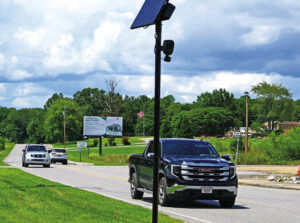
One Flock camera has been installed in Red Bay while the proposed policy governing its use remains under consideration by the council. The camera is on Golden Road near Hospital Road and Gates Road.
Police Chief Janna Jackson said the camera is operating, but officers are not accessing information from the system while waiting for the city to adopt the state-required license plate recognition policy.
She said officers drove a Red Bay police vehicle past the camera to see what type of image it captured. The image displays the rear of the patrol vehicle and its license plate.
Jackson said the demonstration was the department’s only use of the system so far.
“On our cameras, the only information that is collected is a picture of a person’s license plate,” Jackson said. “There is no facial recognition. There’s no personal information that’s being gathered from these vehicles other than a picture of their license plate. There’s nothing this camera captures that is not already in plain public view.”
Jackson said the department requested the cameras because investigators have relied on neighboring agencies that already use the Flock Safety network.
“The reason why we decided we really wanted these cameras is to help as an investigative tool,” she said. “Up to this point, we’ve been asking other agencies to assist us in investigating specific crimes by running tags or vehicle descriptions through their Flock Safety cameras.”
She said the system could help investigators locate abducted children, stolen vehicles and wanted suspects.
Jackson said information collected by the system would be accessed and shared only in connection with criminal investigations.
“We would definitely want to share the information if another agency was looking for a specific vehicle that was involved in a crime in their city,” she said.
“Everything has to be done based on criminal activity. We do not have the legal right, nor does any other agency, to view any data that is not related to a crime.”
After the meeting, Vinson said the council supports giving law enforcement effective investigative tools.
“We just want to do our due diligence,” he said. “We want to put forth all the tools we can to help our police department catch people committing crimes and protect our people. But at the same time, we want to hear all the information there is and make sure that we’re making a good, solid decision.”
Vinson said he also wants to get more input from the public. He said he hopes the council can adopt safeguards that address residents’ concerns while allowing officers to use the technology appropriately.
“[I hope we can] find common ground to where we can be able to use the product and also have a secure way to have the data used just for criminal activity,” he said.
Vinson said a second Flock camera has been purchased for the Highway 19 entrance to the city but has not yet been installed.
He said the city has a draft policy on Flock camera use, but no councilapproved policy currently governs the system.
City Clerk Hannah Baggett said the cameras are being paid for through the city’s equipment fund. Installation costs a onetime $800. The annual subscription is $3,000 per camera for a 36-month contract.
Jackson said she understands why residents want to review the proposal before it is adopted.
“This policy is straight from the state of Alabama,” she said. “Multiple agencies in Alabama use the same policy. I don’t foresee anything needing to be changed. I do understand everyone taking the time to review the policy carefully before putting it in place.”