


Firefighters must stay ready for emergencies at all times
RUSSELLVILLE — From operating the department’s aerial truck to practicing rope rescues and dive boat operations, city firefighters spend hours each week training for emergencies they hope never happen.
Training is a regular part of the workweek with two to three hours set aside Monday through Wednesday. The department operates three shifts, and each shift works on the same training subject during the week.
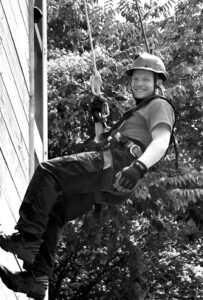
One week might focus on positioning the aerial truck and flowing water from its tower. Another might have firefighters rappelling from the department’s four-story training tower. The next could take them onto the water to practice operating the rescue boat, using sonar and placing buoys.
“We wear many hats,” Deputy Chief Randy Seal said.
The department’s aerial truck is still relatively new, and Seal said firefighters train with it about once a month and sometimes more often. Crews practice connecting water, pulling and charging attack lines, and operating the tower.
Because the truck is larger than equipment the department has used in the past, he said crews also practice positioning it around the city, for instance, at three- and four-story apartment complexes so they know where it can be safely operated if needed.
City firefighters also make up the majority of Franklin County’s dive team. Training on the department’s rescue boat includes using sonar and other equipment that could be needed to search for a missing person or recover a body.
The department also serves as Franklin County’s hazardous materials team and is designated as a medium rescue team by the state.
Seal said many firefighters are trained in two or three rescue disciplines with those who have specialized training taking the lead when a call requires those skills. Training includes rope, confined space, trench and wilderness rescue.
Basic rope training begins in rookie school, where firefighters learn to put on a harness, tie figure-eight knots and rappel.
Firefighters use a fourstory tower and two shipping containers to practice searches, locating victims and rescuing a firefighter who goes down inside a building. Seal said a third container is being added to create a two-story training area.
The department currently has 18 career firefighters, including two recent hires, and 10 volunteers.
Firefighter Grant Tarascou serves as the department’s training coordinator. Seal said Tarascou plans training several months at a time and keeps track of the hours firefighters need in different categories to meet state and Insurance Services Office requirements.
“We try to stay current and keep our skills honed,” Seal said.