


Dual enrollment students explore county’s history
RUSSELLVILLE — Students from Belgreen and Vina stepped out of their online history class and into Franklin County’s past this fall as part of a dual enrollment project led by instructor and coach Richie Hester.
Partnering with Northwest Shoals Community College, Hester said he structures the course around the history found in the towns and backroads his students see every day.
He said he wants his students to understand the county in a way a laptop screen cannot offer.
“This county holds more history than most people realize, and I want them to see it for themselves,” he said.
The field trip covered multiple sites tied to early settlement and community development.
Hester planned the day so the students could walk through places connected to early families and experience the layout of the county more than 200 years ago.
Their first stop was Old Town Cemetery. The Sevier family plot is there, including Bonnie Kate Sevier, whose remains were moved years after her death so she could be reburied beside her husband, John Sevier.
Hester used the site to show how early families shaped communities and made decisions that altered family histories.
Students from Belgreen and Vina visited the Harris Plantation in Russellville. The site dates back about two centuries.
The group then visited Sadler Cemetery. Hester often uses cemeteries when he teaches local history because they show who lived in the region and how families spread across the area.
He pointed out most students told him they had driven past both cemeteries without knowing who was buried there.
At the Franklin County Archives, students studied records, maps and photographs tied to early settlement.
Layla Hester said researching genealogy helped her understand how the sites are connected to families she grew up around.
“We got to look up family history,” she said. “Seeing your family tree laid out makes it personal.”
Hester next brought the students to Russellville Cut Stone, the former quarry that produced markers and stonework used beyond the county.
He once worked as the plant superintendent at Alabama Limestone. He brought photos showing buildings and monuments constructed with stone from the site.
The group also visited the DeVaney Cabin in Russellville. Alhough the cabin has been renovated, the structure still shows the style and scale of early homes in the region.
Hester said historic structures help students imagine the daily lives of the county’s early settlers.
Later in the day they visited the Harris Plantation in Russellville. The site dates back about two centuries.
Hester said John Harris taught school there and played a major role in early education in the county.
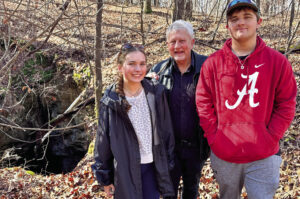
After the main portion of the trip, Hester returned with a few students to an opening connected to the underground lake system. He said natural features like this help show how geography shaped settlement patterns and the way early residents used caves for shelter.
He said the underground lake system has long figured into local accounts. He cited an example of Confederate soldiers hiding in parts of the cave system near the end of the Civil War when Union troops moved through the area.
He said people inside the cave could sometimes hear horses passing on the ground above.
Students said the experience changed how they viewed the place where they grew up. Rush Berryman said the day showed him how much he had overlooked.
“There’s a lot more in Franklin County than most people realize,” he said. “I didn’t know there was so much here.”
He said the cemeteries and the plantation made the strongest impression.
A second student, Ty Hamilton, said the project helped him understand how easy it is to pass important places without knowing their stories.
“I’ve lived here my whole life,” Hamilton said. “You drive past something and think, ‘Oh yeah, a cemetery,’ but you never really go into the history. I’m glad we did that. It’s something you can tell your kids and your grandkids.” He said remembering local history makes it easier to explain what makes the area meaningful.
“It’s always good to know where you came from and how things started,” he said. “If somebody asks what’s special about this place, you should be able to tell them.”
Hester said many people helped make the trip possible.
He thanked Chief Hargett and the officers with the Russellville Police Department who guided the group and helped the students feel comfortable at each stop. The officers gave the students hats and memorial buttons.
Hester said he hopes projects like this keep students connected to the places they see every day and help them understand how the county developed.
He said that if students leave the course with a fuller sense of place, the project has done its job.
“If they can look at their hometown with new eyes,” he said, “then we’ve accomplished something worth doing.”