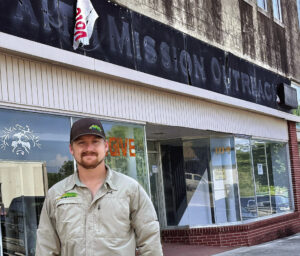



Bonner’s interest in Declaration of Independence spans 50 years
PHIL CAMPBELL — More than 27 copies and reproductions of the Declaration of Independence are displayed in frames throughout Jim Bonner’s home. There are more in the basement.
What began as an extension of a lifelong interest in collecting coins has grown over the decades into a collection of historical books, documents, and reproductions connected to the Declaration of Independence.
Bonner has spent about 50 years studying the document, its history and the many versions printed and reproduced since 1776.
He said collecting has interested him since childhood, whether the objects were eggs, leaves, shells or coins.
Jim Bonner studies the size of the printed text, the paper, watermarks, and other physical characteristics that may offer clues about when and how a copy was produced.
“It gives me a great deal of joy, and then when you get older, you still have that spark of joy of collecting inside you,” he said.
A new acquisition often begins another investigation, Bonner said.
“If I get a new copy, it’s going to be an obsession for some time, trying to get every detail about the paper,” he said.
He studies the size of the printed text, the paper, watermarks, and other physical characteristics that may offer clues about when and how a copy was produced.
Bonner recalled acquiring what appeared to be an older reproduction of what he said is known as the Goddard broadside. The paper, folds and printing initially seemed convincing, but the dimensions raised questions.
“It feels right and it looks right, but something’s off,” he said.
For Jim Bonner, what began as an extension of an interest in collecting coins has grown over the decades into a collection of historical books, documents and reproductions connected to the Declaration of Independence.
His research led him to conclude that it was probably produced for the nation’s bicentennial in 1976.
“It is an antique,” Bonner said. “It’s something that was probably made in 1976 for the bicentennial, but it is not 200 years old.”
Among the items in his collection are old volumes containing the writings of Thomas Jefferson and different versions and reproductions of the Declaration.
Bonner acquired a fourvolume set of Jefferson’s works printed in 1829 and found a folded copy of the Declaration inside one of the volumes.
“The joy of finding that and then folding out that copy will only happen once,” he said.
When he acquired it, Bonner said he knew what the volume was supposed to contain but did not know everything that would be inside.
He said studying the history surrounding the Declaration has become as important to him as collecting copies. Understanding the document requires studying the people, events and ideas surrounding its creation.
“It’s an enormous undertaking to look at it [the Declaration] in context and say, what did this phrase mean? Who were they talking to?” Bonner said.
Jim Bonner and his wife, Linda, live in Phil Campbell.
His research began long before information could be found with a few keystrokes.
Bonner was a student worker at the Phil Campbell library when he was young. He said many books still on its shelves are books he helped order or place there.
“I often said when I was younger that you didn’t really need an education,” Bonner said. “What you needed was the ability to read and a library card.”
He continues to value printed material, noting he keeps books in part because “the internet changes.”
Bonner said researching history requires considering different perspectives rather than relying on a single author or source.
“Everybody is biased, and you’ve got to develop your own opinion,” Bonner said. “You’ve got to read a point and counterpoint on every argument, everything out there. Otherwise, you’re just mimicking what somebody else knows.”
Bonner has collected coins for at least 70 years, he said, and sees his interest in historical documents as a natural extension of that hobby.
He said collectors should begin with something that genuinely captures their curiosity.
“Pick a subject. Pick something that resonates with you,” Bonner said, “something that just causes your brain to go, ‘Hey, that’s something I want to know more about.’
“It’s not about the value,” he said. “It’s about the soul.”
Bonner and his wife, Linda, have found room for the growing collection throughout their home with additional items stored in the basement and a spare bedroom.
Bonner said he no longer spends much time searching auctions, estate sales or antique shops for copies, although the search continues online.
“I look on eBay practically daily,” he said.
Despite the size of his collection, Bonner is still looking for one particular item — a Peter Force copy of the Declaration.
He owns an old volume similar to the kind of book that could contain one, but his volume does not include the Declaration.
Bonner believes an undiscovered copy could remain folded in an old book on a library or courthouse shelf, overlooked by people who do not know what they are seeing.
“When I find it, it’ll be a book that looks just like this, all dirty and torn, and I will probably have a heart attack when I find it,” Bonner said.
For now, he considers his collection likely finished with that one exception.
“The Peter Force is out there, and people just don’t know where it’s at,” he said, adding that they may not recognize it when they hold it in their hands.
After about 50 years of studying the Declaration, Bonner said the document continues to offer something new. “Every time you read it, you get a different message,” he said. “You get something that was hard for you to understand the first time. It’s not just the words on the paper. It’s something about the very nature of man and what we are here to do.”