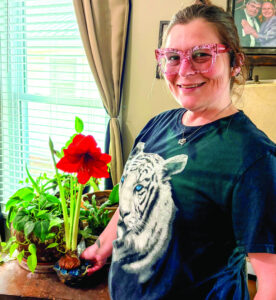


Growing an amaryllis indoors
What you need:
A container wider than the bulb, rocks and a small amount of water.
How to set it up:
Place rocks in the container about halfway up. Set the bulb on top, then add more rocks around it.
Water tip:
Add enough water to touch the roots, but not the bottom of the bulb.
Why people like it:
A clear container lets people watch the roots grow toward the water.
Watch for:
Tall stalks may need staking. Too much water can cause rot.
Light:
Brighter light helps the stalks and buds grow faster.
After it blooms When to move it:
After the foliage dies back.
What to do:
Leave the greenery on until it dies naturally, then plant the bulb outside.
Planting depth:
Mary-Kathryn Wiggins said she and her husband, Andy, plant theirs about five inches deep.
Outdoor timing:
Melody Pearson said bulbs can be planted outdoors after the last frost.
RED BAY — For Red Bay Garden Club member Melody Pearson, planting amaryllises has become an annual tradition. For the last two years, she led the club’s annual gathering to plant them. She cited a love of the flower’s bold blooms, varied colors and need for relatively simple care among the reasons why she finds them so appealing.
“The blooms are absolutely gorgeous,” Pearson said. “There are multiple colors. They don’t take long to bloom. You get to watch them grow, and it’s just like ‘overnight’ that they go from bulb to stem to greenery to bloom.”
Pearson said amaryllises typically bloom within six to eight weeks after planting.
She said the flowers usually last a couple of weeks, though some can continue longer depending on the number of buds and bloom stalks.
She also described the flowers as large and showy once they open. “The blooms are big, like a saucer,” she said.
Pearson said amaryllises come in a range of colors and forms, including pink and white blooms, burgundy shades and double bloom varieties.
Fellow club member Mary-Kathryn Wiggins, who said she planted four of the flowers this year, described one of hers as a ruby red that is “almost iridescent.”
The group planted the bulbs in glass containers with rocks rather than soil. Pearson said this method lets growers watch the roots develop as the plant grows.
Wiggins said the clearcontainer setup is part of what she likes most about the project. Another club member, Tracie Clark, said the blooms add cheer to everyday spaces at home.
“It will bloom, and it brightens my kitchen. I love it,” Clark said.
Wiggins said she likes the plant’s hardiness.
“They’re just so resilient, and no matter what circumstances they find themselves in, they’ll find a way to bloom,” she said.
Wiggins said the bulb can be placed in a container wider than the bulb itself with rocks filled about halfway before more rocks are added around it. She said the water should be high enough to touch the roots but not the bottom of the bulb.
Pearson likewise said growers should keep the water level below the bulb and root line to help prevent rot.
Clark said amaryllises do not need much water. She said she simply watches hers and may give it a small amount every two or three days.
Pearson said the tall stalks may need to be staked, and that brighter light helps the plants grow faster. She said amaryllises can be planted outdoors after the last frost, while Wiggins said she and her husband, Andy, move theirs into the ground after the foliage dies back.
Pearson said bulbs planted properly outdoors generally do well in this area year-round.
“If you plant them below the frost line, anything below where the greenery comes out needs to go under the dirt,” she said. “If you do that, they generally do not freeze in our area.”