


Hill addresses challenges before congressional panel
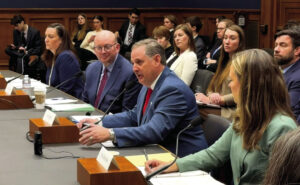
RUSSELLVILLE — Eric Hill, general manager of the Russellville Water and Sewer Board, traveled to Washington, D.C., last week to speak before Congress about the challenges facing small water systems across the country.
Hill testified Feb. 24 before the U.S. House of Representatives Committee on Energy and Commerce Subcommittee on Environment during a hearing titled “From Source to Tap: A Hearing to Examine Challenges and Opportunities for Safe, Reliable, and Affordable Drinking Water.”
Hill has more than 30 years of experience in water and wastewater operations. He testified on behalf of the National Rural Water Association (NRWA) and the Alabama Rural Water Association. He serves on the NRWA Board of Directors, chairs its Regulatory Committee and is vice president of the Alabama Rural Water Association Board.
Hill said he was nominated because of his work on regulatory issues and state revolving funds. After a phone interview and review process, he was selected to represent small systems at the hearing.
“The hardest part was getting to Washington during a snowstorm,” Hill said. “Flights were canceled and I had to fly to Dulles and get an hour-long Uber. I had to leave a day early, but we made it happen.”
Small and rural systems make up about 91% of the nation’s nearly 50,000 community drinking water systems. Hill told lawmakers those systems must meet the same federal rules as large city utilities, even though they often have fewer workers and fewer resources.
In Russellville, 26 employees operate both a drinking water plant and a wastewater treatment facility. The system does not have in-house engineers, lawyers or full-time compliance staff. Hill said the State Revolving Fund is one of the most important tools available to small communities. Russellville is managing about $2 million in active projects through the program, including $1 million in Drinking Water funds and $1 million in Clean Water funds.
Those funds paid for a new Supervisory Control and Data Acquisition (SCADA) system, water main repairs, an upgrade to a booster station which serves about half of the city’s water customers, and improvements at the wastewater treatment plant.
The wastewater treatment project restored 7.5 million gallons per day of capacity after nearly 30 years without a major upgrade.
Hill said small systems often wait years to see funds move through the process, even after being approved.
“We applied in 2022 and some of those funds are just now rolling out in 2026,” he said. “There’s a shortage of contractors and engineers and materials, and the prices are a lot more than they originally allocated.”
Hill also spoke about a growing workforce shortage. He said up to half of water system operators are expected to leave the field within the next 10 years. Through the NRWA Registered Apprenticeship Program, 35 state rural water associations now offer federally approved programs designed to train new operators. More than 1,200 apprentices have enrolled or completed the program so far.
He told lawmakers rural systems depend on federal technical assistance and training to stay in compliance and operate safely.
Hill also addressed concerns about PFAS, a group of man-made chemicals found in water systems nationwide. He said water and wastewater systems are not the source of the contamination but are responsible for treating it. He voiced support for HR 1267, the Water Systems PFAS Liability Protection Act, which would protect water utilities from certain federal liability claims.
“It was a great opportunity for me to represent and advocate for these small water systems,” he said. “That’s my job.”